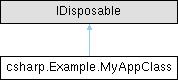
Wraps CorelinkClient with an example of a full lifecycle: init → auth → workspaces → create sender → create receiver → send data → teardown.
More...
|
| | MyAppClass (string endpoint=CorelinkDefaults.Endpoint, int controlPort=CorelinkDefaults.ControlPort, string username=CorelinkDefaults.Username, string password=CorelinkDefaults.Password) |
| |
| async Task | InitAsync () |
| |
| async Task | GetWorkspacesAsync () |
| |
| async Task | CreateSenderAsync (string workspace=CorelinkDefaults.Workspace, string streamType=CorelinkDefaults.StreamType, string protocol=CorelinkDefaults.Protocol, string meta="", bool alert=true, bool echo=true) |
| |
| async Task | CreateReceiverAsync (string workspace=CorelinkDefaults.Workspace, string streamType=CorelinkDefaults.StreamType, string protocol=CorelinkDefaults.Protocol, string meta="", bool alert=true, bool echo=true) |
| |
| async Task | SendDataAsync (byte[] data, JObject headers=null) |
| |
| async Task | TeardownAsync () |
| |
| void | Signal () |
| |
| async Task | WaitForSignalAsync (int timeoutMs=30000) |
| |
| void | Dispose () |
| |
Wraps CorelinkClient with an example of a full lifecycle: init → auth → workspaces → create sender → create receiver → send data → teardown.
◆ MyAppClass()
| csharp.Example.MyAppClass.MyAppClass |
( |
string | endpoint = CorelinkDefaults::Endpoint, |
|
|
int | controlPort = CorelinkDefaults::ControlPort, |
|
|
string | username = CorelinkDefaults::Username, |
|
|
string | password = CorelinkDefaults::Password ) |
|
inline |
◆ CreateReceiverAsync()
| async Task csharp.Example.MyAppClass.CreateReceiverAsync |
( |
string | workspace = CorelinkDefaults::Workspace, |
|
|
string | streamType = CorelinkDefaults::StreamType, |
|
|
string | protocol = CorelinkDefaults::Protocol, |
|
|
string | meta = "", |
|
|
bool | alert = true, |
|
|
bool | echo = true ) |
|
inline |
◆ CreateSenderAsync()
| async Task csharp.Example.MyAppClass.CreateSenderAsync |
( |
string | workspace = CorelinkDefaults::Workspace, |
|
|
string | streamType = CorelinkDefaults::StreamType, |
|
|
string | protocol = CorelinkDefaults::Protocol, |
|
|
string | meta = "", |
|
|
bool | alert = true, |
|
|
bool | echo = true ) |
|
inline |
◆ Dispose()
| void csharp.Example.MyAppClass.Dispose |
( |
| ) |
|
|
inline |
◆ GetWorkspacesAsync()
| async Task csharp.Example.MyAppClass.GetWorkspacesAsync |
( |
| ) |
|
|
inline |
◆ InitAsync()
| async Task csharp.Example.MyAppClass.InitAsync |
( |
| ) |
|
|
inline |
◆ SendDataAsync()
| async Task csharp.Example.MyAppClass.SendDataAsync |
( |
byte[] | data, |
|
|
JObject | headers = null ) |
|
inline |
◆ Signal()
| void csharp.Example.MyAppClass.Signal |
( |
| ) |
|
◆ TeardownAsync()
| async Task csharp.Example.MyAppClass.TeardownAsync |
( |
| ) |
|
|
inline |
◆ WaitForSignalAsync()
| async Task csharp.Example.MyAppClass.WaitForSignalAsync |
( |
int | timeoutMs = 30000 | ) |
|
|
inline |
◆ OnDataReceived
| Action<int, JObject, byte[]> csharp.Example.MyAppClass.OnDataReceived |
|
getset |
◆ OnError
| Action<string> csharp.Example.MyAppClass.OnError |
|
getset |
The documentation for this class was generated from the following file: